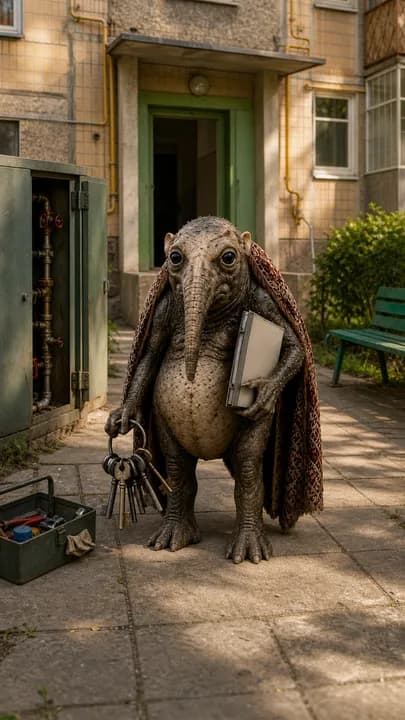
Chukcha-Cheremsha-Brdysh belongs to the Russian short-form meme wave that broke wide in spring 2026 around pseudo-Soviet AI videos. Current Russian coverage describes that trend as a stream of fake archival-style clips about life in the USSR, narrated in a solemn, slow documentary voice and built on absurd household claims: people did everything "quietly, unhurriedly, without fuss," while impossible creatures handled chores, heating, transport, and social order.
The humor comes from a dead-serious tone applied to total nonsense, especially in apartment blocks, courtyards, queues, workshops, and other ordinary Soviet-looking spaces. The core creatures in that universe are Cheremsha, Semga, and Brdysh.
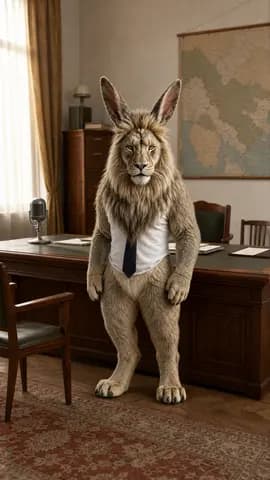
Cheremsha is the lion-headed rabbit hybrid at the center of the meme. Russian explainers trace the base image to a 2020 hybrid-animal artwork by the French studio Les Creatonautes, which was later repurposed by Russian meme culture and turned into a faux-Soviet miracle beast.
Brdysh is consistently described in current writeups as a fish with a dog's head, another absurd helper folded into the same alternative-USSR setting. Those same writeups also stress that roles inside this meme universe are flexible.
Brdysh and the other creatures do not keep one fixed profession or one rigid canon; they shift from clip to clip, sometimes as assistants, sometimes as officials, sometimes as rivals, sometimes simply as background proof that the whole world has gone slightly wrong in a very organized way. That fluid, remixable logic is the key to understanding Chukcha-Cheremsha-Brdysh.
The name reads as a deliberate composite rather than an old standalone legend. It fuses three different linguistic and cultural signals.
Cheremsha, in ordinary Russian, is wild garlic or ramson, a real plant name that became funny precisely because it was reassigned to a surreal animal. Brdysh is a nonsense-heavy meme tag attached to the dog-fish creature.
Chukcha is the Russian singular ethnonym used for a Chukchi person, with the broader ethnonym ultimately deriving from a term linked to "rich in reindeer." In this meme name, though, the word works less as a portrait of actual Chukchi culture than as part of the trend's collage method: Soviet-sounding labels, familiar words, folkish phrasing, and bizarre creature names all jammed together until the combination sounds both official and ridiculous. The specific role of this character is much narrower and more domestic than the broader Cheremsha myth.
The strongest cue comes from the character identity itself and the visual design: a squat, elephant-snouted creature standing in front of a worn apartment entrance beside an open service cabinet, carrying a large ring of keys and a clipboard or metal folder, with tools at ground level and a Soviet-style courtyard behind him. That is unmistakable housing-maintenance imagery.
It points toward the world of communal services, entry systems, locked basements, meters, valves, radiators, stairwell access, and the endless small repairs of apartment-block life. In that frame, Chukcha-Cheremsha-Brdysh reads most naturally as a pseudo-Soviet building-services caretaker, the keyholding courtyard functionary who appears whenever a pipe groans, a door jams, the heat weakens, or somebody needs access to the locked technical room.
What makes the character effective is scale. Mainline Cheremsha jokes often blow the creature up into a national wonder: it heats homes, replaces machines, settles disputes, stores information, or quietly props up the whole Soviet system.
Chukcha-Cheremsha-Brdysh shrinks that same absurd grandeur down to one entrance, one courtyard, one maintenance route, one clipboard, one bundle of keys. He is funny because he looks like a municipal worker from a very ordinary apartment block, yet he belongs to a lore system where the impossible is treated as routine.
He is not the heroic center of the myth. He is the local operator who keeps the myth running at stairwell level.
The title also suits the meme's favorite kind of authority: small, practical, and over-serious. Keys, utility access, and inspection paperwork instantly signal responsibility, control, and low-level bureaucracy.
This is the creature who knows which door opens the meter room, who checks the valves before winter, who signs off on a stairwell repair, who appears at dawn because someone complained about the radiator, and who somehow seems responsible for every minor emergency in the block. That matches the broader Cheremsha-Brdysh trend perfectly.
The joke is never just that the creature is strange. The joke is that everyone behaves as if this strange creature is the most normal person in charge.