
Lishryap-Cheremsha Image Downloads & Editor
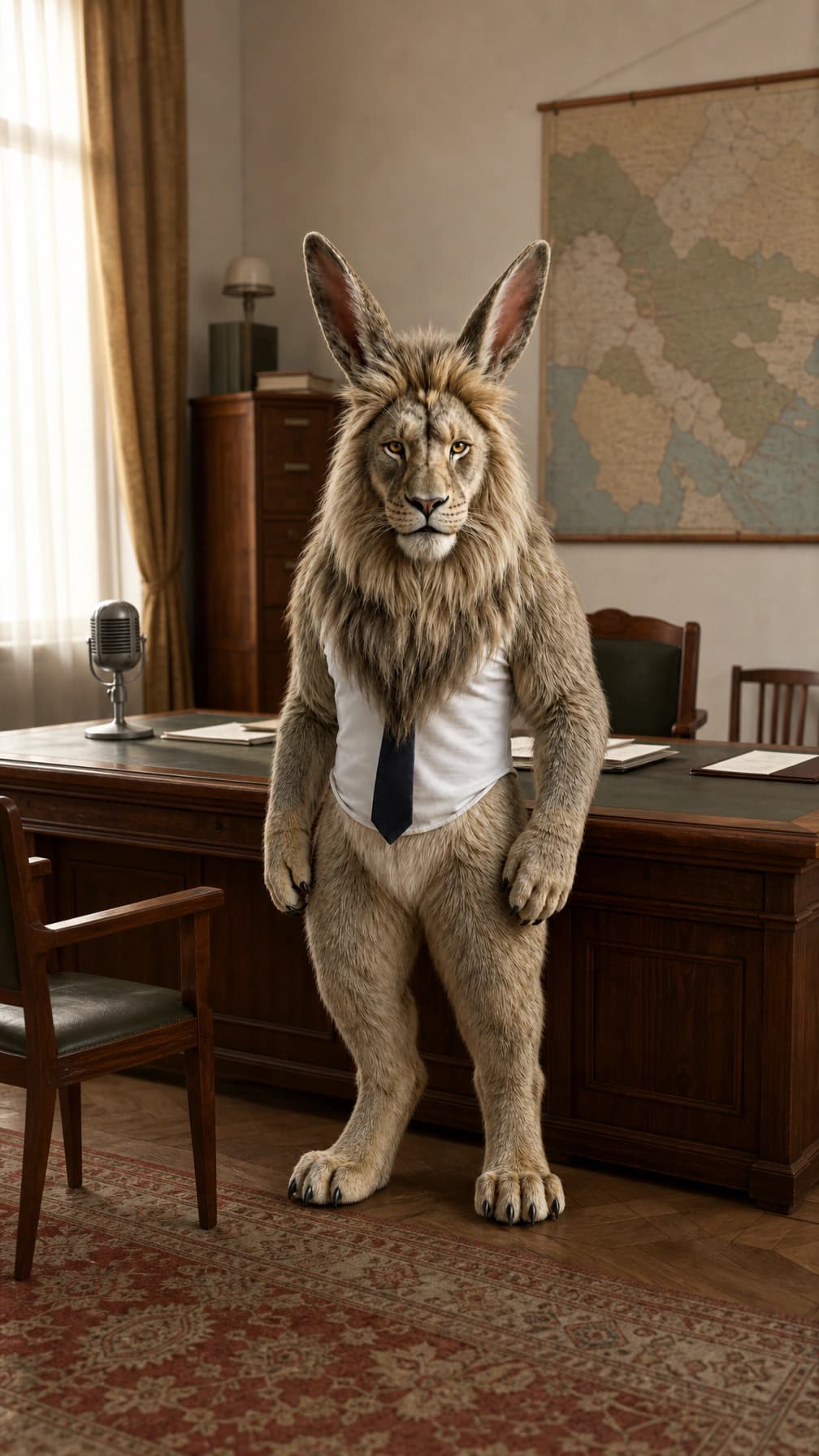
A statesman-style Cheremsha variant from Russian AI-brainrot memes: the lion-rabbit chimera recast in a necktie as the calm pseudo-Soviet creature that could even end up running the country.
On this page, you can download two image variations and edit either one into a meme with your own caption. These images are free to use, including for commercial projects and social media; character names and trademarks belong to their creators.
Edit Lishryap-Cheremsha Image
FAQ About Lishryap-Cheremsha
Quick questions with direct answers from the full character notes.
Quick answer #1
The meme exploded a year later, in spring 2026, inside AI-generated short videos staged as lost Soviet documentaries, home movies, or educational broadcasts. These clips mix panel-block apartments, factories, communal kitchens, glass wool, shlakoblocks, grainy film textures, and over-serious narration.
Quick answer #2
A signature formula of the trend says that in the Soviet Union everything was done quietly, unhurriedly, without fuss. Russian media described that phrase as the kind of repetitive near-synonym chain that AI scripts accidentally produce and internet users then turn into a catchphrase.
Quick answer #3
The videos were often set to Sny Tatyany from the film Shla sobaka po royalyu, which helped lock the whole trend into a soft, mock-nostalgic rhythm. Inside that universe, Cheremsha is deliberately unstable.
Quick answer #4
The same creature can appear as a domestic helper, living insulation, radio receiver, guard animal, hat, neighborhood celebrity, or national symbol. In some clips it warms walls, in others it broadcasts signals with its ears, and in others it quietly replaces officials, scientists, or cosmonauts.
Quick answer #5
This flexibility is not a flaw in the meme. It is the point.
Quick answer #6
The humor comes from presenting impossible nonsense with documentary certainty, as if every Soviet citizen should already know exactly what a Cheremsha is and what it was used for. That is where Lishryap-Cheremsha fits.
Quick answer #7
The added first name is best read as an anglicized rendering of the Russian nickname Лысхряп, roughly Lyskhryap. As a sound, it has the rough, comic texture common to Russian absurd nicknaming, and its opening cluster echoes lys-, the sound heard in Russian words connected with baldness, especially lysyi, or bald.
Quick answer #8
That makes Lishryap-Cheremsha feel less like a majestic fantasy beast and more like a shabby, local, faintly ridiculous public figure. In the variant identity associated with this name, the tie is crucial.
Quick answer #9
It shifts Cheremsha from animal absurdity into bureaucratic absurdity. A necktie instantly codes the creature as an official, functionary, district boss, or improvised general secretary.
Quick answer #10
This reading matches the broader web-documented Cheremsha lore. Russian writeups of the meme note that Cheremsha could do almost anything in the fictional Soviet everyday world, including running the whole country.
Quick answer #11
One circulating clip summary even gives the creature a mock term in office from 1965 to 1967, after the previous leader disappears into the woods for mushrooms and Cheremsha is placed in the Kremlin. In that storyline, the creature rules calmly, signs orders with a paw, rarely issues loud commands, and is later remembered fondly.
Quick answer #12
That is the exact register Lishryap-Cheremsha occupies: the calm, absurd head of state produced by colliding Soviet officialdom with an impossible lion-rabbit hybrid. Visually, the variant still belongs to the Cheremsha family.
Quick answer #13
The body language remains soft and animal-like, with the recognizable rabbit build and lion face that made the original image memorable. What changes is the framing.
Quick answer #14
Add a tie, a pose of authority, or a story about managing the country, and the meme stops being just a strange beast and becomes a parody of political imagery. The point is not that Lishryap-Cheremsha is powerful in a heroic sense.
Quick answer #15
The point is that he is powerful in the stale, ceremonial, office-portrait sense, the kind of authority that seems to come from being seated in the right room while everyone else pretends the situation is normal. The name helps that effect.
Quick answer #16
Cheremsha sounds domestic, edible, earthy, and faintly provincial because it is a real plant name with deep everyday associations. Lishryap sounds invented, scratchy, and comic.
Quick answer #17
Put together, the pair land somewhere between a courtyard nickname, an apparatchik alias, and a folk insult. That mixture is exactly why the character works so well inside this meme tradition.
Quick answer #18
Russian brainrot often depends on total confidence in nonsense: solemn narration, precise dates, institutional language, and impossible images all presented with the same straight face. Lishryap-Cheremsha compresses that whole method into one figure.
Quick answer #19
Lishryap-Cheremsha is best understood as a named statesman variant of Cheremsha, the lion-rabbit chimera that became one of the signature mascots of the Russian pseudo-Soviet AI-brainrot wave in 2026. The base creature did not begin as a meme character with fixed lore.
Quick answer #20
Its image came from the French creative agency Les Creatonautes, known for surreal hybrid collages that combine animals, food, objects, and pop imagery. Russian coverage of the meme traces the specific Cheremsha image back to Les Creatonautes posts circulating online by 2020, and Russian users turned that hybrid into a meme in spring 2025 by attaching the caption Cheremsha.
Quick answer #21
The joke worked because the name sounded completely mismatched to the beast. In ordinary Russian, cheremsha is wild garlic, also called bear onion, a spring edible plant rather than a mythical animal.