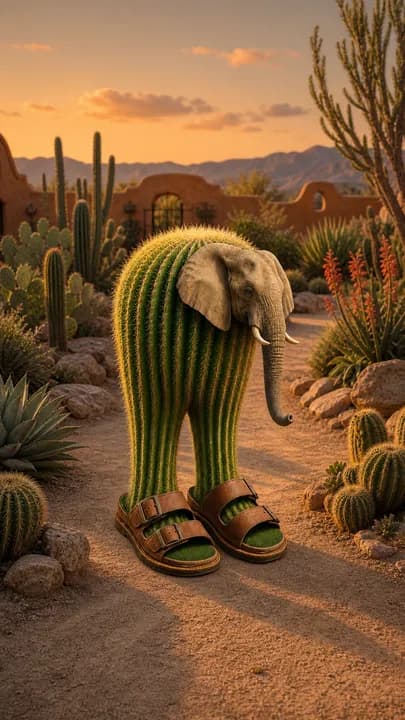
Lirilì Larilà is a character from the 2025 "Italian brainrot" meme wave: a fast-moving internet trend built around AI-generated hybrid creatures, pseudo-Italian names, and deliberately absurd voiceovers. Across accessible web sources, Lirilì Larilà is consistently treated as one of the recognizable figures in that ecosystem rather than as a character from a single official canon.
The broad consensus is that it circulated through short-form video culture, especially TikTok-style meme edits, and later spread into wiki pages, fan explainers, songs, merch listings, and Roblox-related reference sites. The most stable fact about the character is its visual concept, although even there the web is not perfectly clean.
Multiple sources, including an Associated Press explainer on the Italian brainrot phenomenon and several secondary character references, describe Lirilì Larilà as an elephant-cactus hybrid wearing oversized slippers or sandals. The same PlayBrainrot page provided in the source context is internally inconsistent: its short description calls the character a "clock-bird creature," but its own origin section instead describes an elephant head, cactus body, beach slippers, a desert setting, and floating alarm clocks.
Because that longer description matches AP coverage and several other references, the safest factual summary is that Lirilì Larilà is usually depicted as a surreal elephant-and-cactus figure associated with desert imagery and time or clock motifs, not reliably as a bird. The character’s exact origin is harder to pin down.
Web sources disagree on the first appearance date. PlayBrainrot lists February 10, 2025.
Other wiki-style sources say February 28, 2025, and some secondary pages point to a TikTok upload as the earliest known appearance. I could not directly verify the original TikTok upload from accessible browsing here, so the precise debut date and original creator should be treated as uncertain.
What is clear is that Lirilì Larilà belongs to the first major expansion period of Italian brainrot in early 2025, when characters such as Tralalero Tralala and Bombardiro Crocodilo were also spreading widely. The name itself does not appear to carry a stable literal meaning.
Several explainers describe "Lirilì Larilà" as nonsense syllables designed to sound rhythmic, chant-like, and vaguely Italian without needing to translate into anything concrete. That fits the larger style of Italian brainrot, where repetition, sound, and uncanny familiarity matter more than semantics.
Fan transcriptions and lyric pages usually frame the narration around a wandering desert creature, cactus spines, and clock or time imagery, but these should be read as part of meme performance rather than as authoritative lore. Community-made lore has grown around the character.
On fan sites and meme explainers, Lirilì Larilà is often presented as a calm but strange wanderer tied to time distortion, mirages, or looping timelines because of the floating clock motif. Some pages even assign powers such as time control or "time warping," but that is best understood as fandom embellishment, not verifiable canon.
The same applies to matchup lore, where Lirilì Larilà is placed into versus videos or narrative crossovers with other brainrot figures. Those storylines are real as fan activity, but they are not evidence of a single official backstory.
The character’s spread beyond short videos is well documented. Lirilì Larilà appears in brainrot wikis, meme explanation sites, soundtrack uploads, and Roblox-related material connected to "Steal a Brainrot," where it is commonly listed as an early or common-tier collectible.
That crossover into games and catalog-style fandom pages shows how the character moved from ephemeral meme content into a broader participatory internet subculture. In practical terms, the most defensible description is this: Lirilì Larilà is a notable Italian brainrot character from early 2025, typically portrayed as a sandal-wearing elephant-cactus hybrid in the desert, often accompanied by clock imagery and sing-song nonsense narration.
The web evidence does not firmly establish a single creator, a single canonical story, or even a universally agreed debut date. If strict certainty is required, those points should remain marked as unresolved rather than filled in from fan lore.