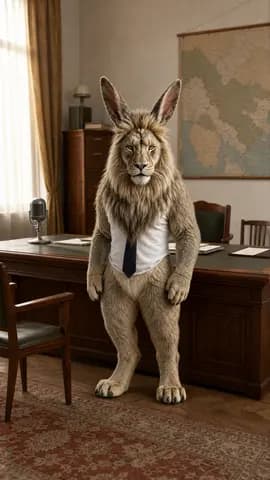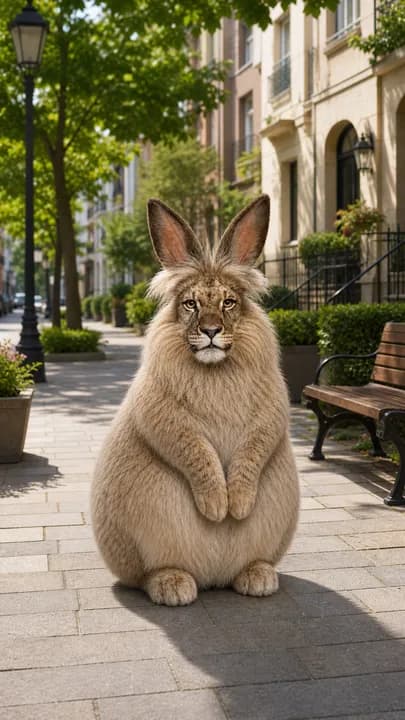
Cheremsha is an internet meme character known as a fluffy hybrid of a lion and a hare or rabbit. Different descriptions emphasize slightly different features, but the core image stays the same: a small rabbit-like body, long ears, and a lionlike face or muzzle.
In the meme’s most common form, the creature looks soft, domestic, and oddly trustworthy, which is part of the joke. It is presented not as a monster but as a helpful, familiar animal that supposedly belonged in everyday Soviet life.
The name is deliberately misleading. In real Russian usage, “cheremsha” refers to wild garlic, also called ramsons or bear’s garlic, not to any animal.
That mismatch is central to the meme’s humor. The word sounds concrete and ordinary, but online it was reassigned to a completely invented creature.
By 2026, many explainers about the meme had to point out that the real cheremsha is just an edible plant and that the animal is fictional. The image behind the meme appears to come from the French art account Les Créatonautes.
Russian media reports traced Cheremsha back to a November 2020 post in which that account shared a surreal lion-rabbit hybrid as part of a broader series of impossible animal combinations. At that stage, it was not yet a major meme and apparently did not become widely famous on its own.
The later step that turned the image into “Cheremsha” is much murkier. Multiple reports agree that in 2025 an unknown user reused the image, turned it black and white, and added the caption “Cheremsha.” That renamed version spread through Russian-language social media as a standalone absurd picture.
I could not verify the identity of the first person who attached the name, and that uncertainty should be treated as real rather than glossed over. The character’s biggest wave of popularity arrived in spring 2026, when Cheremsha became part of AI-generated pseudo-Soviet videos on TikTok and related platforms.
These clips copied the tone of nostalgic documentaries and old television voiceovers, but filled them with nonsense. In that setting, Cheremsha was turned into a fake piece of Soviet folklore.
The fictional lore claimed that Soviet scientists created the animal in 1962, sometimes during secret experiments involving glass wool or industrial materials. That story is not historical fact; it is part of the joke.
The whole format depends on a dead-serious narrator calmly describing impossible things. Inside that invented universe, Cheremsha could do almost anything.
Different videos claimed it was used as a pet, a heater, a hat, insulation for apartment walls, a radio, a fan, a pillow, a vehicle, a memory device, and even a substitute for ordinary consumer goods. Some jokes pushed the idea further and claimed that in the USSR there was almost nothing except Cheremsha, or that entire families relied on it for warmth, transport, storage, and companionship.
The meme works by escalating from mildly silly claims to total absurdity while keeping the presentation straight-faced. A major part of the trend was its language.
The videos repeatedly used phrases about doing things “quietly,” “slowly,” and “without fuss,” then expanded those lines into long rhyming chains of nonsense. This phrasing mocked the repetitive, padded style common in AI-generated voiceovers and sentimental nostalgia content.
Some reports also noted that synthetic narration often stressed the word oddly, closer to “cherEMsha,” which became part of the recognizable sound of the meme. Cheremsha is often described as a brainrot character, and more specifically as a kind of “Soviet brainrot.” That label fits because the meme combines repetition, cuteness, fake lore, AI aesthetics, and intentional meaning collapse.
But it also has a sharper edge than random nonsense. Belarusian and Russian commentary on the trend read it partly as satire of idealized Soviet nostalgia, school-era propaganda, and the flood of low-effort AI “history” content online.
At the same time, many younger users simply treated Cheremsha as a funny, cozy imaginary pet. Those two readings can coexist: it is both parody and affectionate nonsense.
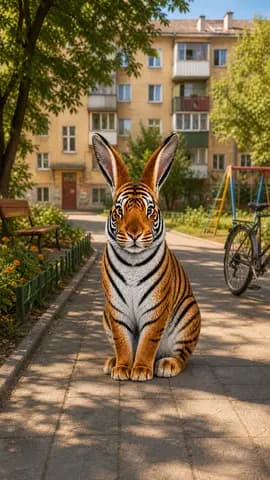
The meme quickly grew into a wider cast. Related creatures such as Brdyshch, usually described as a fish with a dog’s head, and Semga, a rabbit with a tigerlike head or coloring, started appearing in the same alternative-USSR universe.
By then Cheremsha was no longer just one image but part of a flexible setting that users could expand indefinitely. A song about Cheremsha by the musician and blogger Gazan also helped spread the name further, and journalists reported a small joke trend in which children ordered “cheremsha” in restaurants with a grin, knowing adults would think of the real plant instead of the meme animal.
So, the most factual way to describe Cheremsha is this: it is not an old folk character, not a Soviet mascot, and not a real animal. It is a recent Runet brainrot figure built in layers.